Are Peptides Steroids?
No. Peptides are short chains of amino acids. Anabolic steroids are synthetic testosterone. They work differently, carry different risks and are regulated differently.
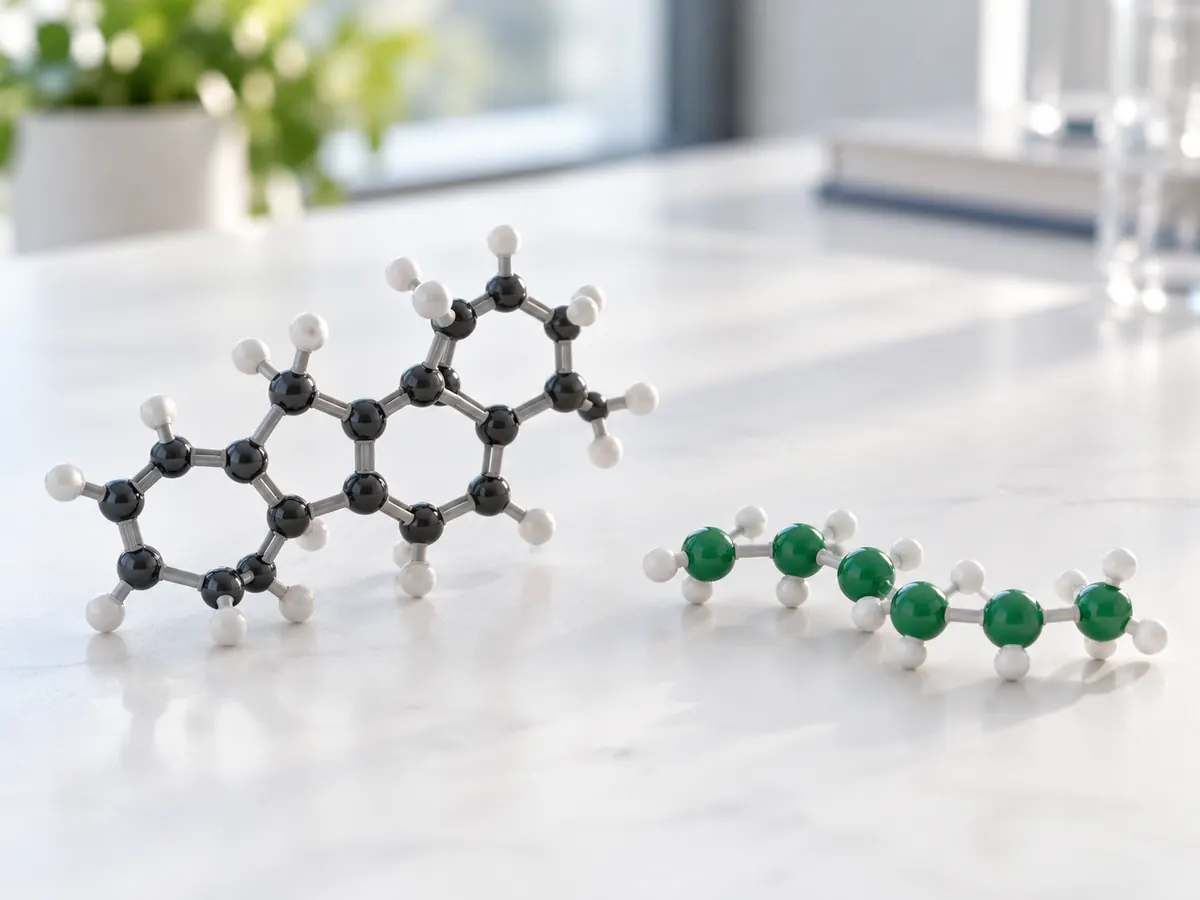
- Peptides: amino acid chains
- Steroids: four-ring hormone molecules
- Steroids: Schedule III in the US

Educational content only, not medical advice. Nothing on this page is a dosing recommendation. Talk to a licensed clinician before using any peptide, hormone or steroid.
The short answer
Peptides are not steroids. A peptide is a short string of amino acids, the same building blocks as protein, that signals cells by binding to receptors on their surface. An anabolic steroid is a man-made version of testosterone. It is built on a fat-soluble, four-ring molecule that slips inside cells and switches on androgen receptors directly.
The confusion is understandable. Both are injected, both are talked about in gyms, and some peptides, such as CJC-1295 (usually the no-DAC form) and ipamorelin, are used to raise growth hormone. But the evidence, the side effects and the law are very different for each.
Peptides vs steroids, side by side
The key differences at a glance.
| Peptides | Anabolic steroids | |
|---|---|---|
| What they are | Short chains of about 2 to 50 amino acids | Synthetic versions of testosterone |
| How they work | Bind receptors on the cell surface and send a signal, often indirectly (for example, telling the pituitary to release growth hormone) | Enter cells and switch on androgen receptors directly, increasing protein synthesis |
| Muscle evidence | Limited Little proof of meaningful muscle gain in healthy people | Strong Large, reliable gains in muscle and strength |
| Your own hormones | Growth hormone peptides are not known to shut down testosterone | Suppressed Natural testosterone and sperm production drop |
| Main risks | Injection-site reactions, unknown long-term effects, contaminated or mislabeled products | Infertility, testicular shrinkage, breast tissue growth, bad cholesterol changes, heart and liver strain, mood effects |
| US legal status | Most are not controlled substances; many are sold as research chemicals not approved for human use | Schedule III Illegal to possess without a prescription |
| Sport (WADA) | GH secretagogues banned (S2); BPC-157 banned (S0) | Banned (S1) |
Different molecules, different jobs
The names sound alike in gym talk, but chemically they have almost nothing in common.
- Peptides are water-soluble chains of amino acids. Because they cannot easily cross the cell wall, they act like a key in a lock on the outside of the cell. Learn the basics in what is a peptide?
- Steroids are fat-soluble molecules built on four connected carbon rings. They pass straight into cells and change which genes are switched on.
- "Steroid" is a broad word. Cholesterol, cortisol and prescription anti-inflammatories like prednisone are steroids too. In fitness, people usually mean anabolic-androgenic steroids.
Which one actually builds muscle?
On muscle alone, the research is not close.
Men given 600 mg of testosterone enanthate a week plus weight training gained about 6 kg of fat-free mass and added 22 kg to their bench press. Even the men who took testosterone without training gained strength. That dose is many times what the body makes on its own.
Bhasin et al., NEJM 1996 (PMID 8637535)
A review of 27 study groups found growth hormone increased lean body mass but did not improve strength or exercise capacity, and caused more swelling and fatigue. Peptides that raise growth hormone have even less evidence for muscle in healthy people.
Liu et al., Annals of Internal Medicine 2008 (PMID 18347346)
Steroids clearly build muscle, and their risks are the price. Peptides are not a "safe steroid": they are a different tool with much weaker muscle evidence. See peptides vs HGH and peptides for muscle growth for what the data does show.
Side effects compared
Anabolic steroids
- Testicular shrinkage, low sperm count and infertility
- Breast tissue growth in men
- Lower HDL, higher LDL and heart strain
- Liver damage, especially with oral forms
- Aggression, dependence and depression after stopping
Research peptides
- Injection-site redness, itching or swelling
- More hunger and water retention with GH peptides
- Higher blood sugar with some GH peptides
- Unknown long-term effects (little human data)
- Contaminated or mislabeled products
Steroid effects are from the DEA drug fact sheet and the Endocrine Society's 2014 statement. For peptides, see peptide side effects and are peptides safe?

The legal difference
- Anabolic steroids are Schedule III controlled substances under the Anabolic Steroid Control Acts of 1990 and 2004. Possessing them without a prescription is a federal crime.
- Testosterone by prescription is legal when a clinician diagnoses low testosterone. Our TRT alternatives guide and testosterone bloodwork guide cover that path.
- Most peptides are not controlled substances. Many are sold as research chemicals not approved for human use. In October 2026, HHS began letting licensed 503A pharmacies compound six peptides by prescription, including BPC-157 and TB-500. That is not FDA approval. See are peptides legal in 2026.
- Sport: WADA bans anabolic steroids (S1), growth hormone and its secretagogues such as ipamorelin (S2), and BPC-157 (S0).
Before you choose either
Whatever you are considering, these steps protect your health and your results.
- Talk to a clinician. If low testosterone is the real issue, prescribed treatment is safer than anything bought online.
- Get baseline bloodwork, including testosterone, lipids, liver enzymes, blood count and IGF-1. Our peptide bloodwork guide lists what to test.
- Track your markers over time with Lab Analysis, so you and your clinician can spot problems early.
- Remember the basics. Training, sleep, protein and calories still drive most muscle gain. See peptide muscle stacks for how peptides fit in.

Frequently asked questions
Are peptides steroids?
No. Peptides are short chains of amino acids that bind to receptors on the surface of cells. Anabolic steroids are synthetic versions of testosterone, built on a four-ring, fat-soluble molecule that enters cells and acts on androgen receptors inside them. They differ in chemistry, effects, risks and legal status.
What is the difference between peptides and steroids?
Steroids act directly on hormone receptors and reliably build muscle and strength, but they shut down your own testosterone production and carry cardiovascular, liver and fertility risks. Most peptides used for fitness work indirectly, for example by prompting the pituitary to release more growth hormone, and their effects on muscle in healthy people are much smaller and less studied.
Do peptides build muscle like steroids?
No research shows that. In a 1996 trial, 600 mg of testosterone a week plus weight training added about 6 kg of fat-free mass in 10 weeks. A review of growth hormone itself in healthy people found more lean mass but no gain in strength, and peptides that raise growth hormone have even less evidence for muscle growth.
Are peptides safer than steroids?
Not automatically. Anabolic steroids have well-documented harms, including hormone shutdown, heart and cholesterol effects, liver strain from some oral forms, and infertility. Most research peptides have less known harm mainly because they have been studied less, and product quality varies a lot between sellers.
Are peptides legal and are steroids illegal?
In the US, anabolic steroids are Schedule III controlled substances, so having them without a prescription is a federal crime. Most peptides are not controlled substances, but many are sold as research chemicals that are not approved for human use. FDA-approved peptide drugs such as semaglutide require a prescription.
Are peptides banned in sports?
Many are. The World Anti-Doping Agency prohibits anabolic steroids under class S1, growth hormone and growth hormone secretagogues such as CJC-1295 and ipamorelin under class S2, and unapproved substances such as BPC-157 under class S0. Tested athletes should check the current WADA list before using anything.
Will peptides shut down my testosterone?
Peptides that raise growth hormone do not work through the testosterone pathway the way steroids do, so they are not known to cause the same shutdown. Anabolic steroids strongly suppress the hormones that tell the testes to make testosterone and sperm. Anyone using either should get baseline and follow-up bloodwork.
Is HGH a peptide or a steroid?
Human growth hormone is a protein hormone made of 191 amino acids, so it is closer to a peptide than a steroid. It is not a controlled substance in the US, but distributing it for uses outside FDA approval is a federal crime. Peptides like CJC-1295 and ipamorelin are different: they prompt your own body to release growth hormone.
See how your body is really responding
Build an educational protocol, then upload your bloodwork to track hormones, lipids and liver markers over time. Free.
Sources
- Bhasin S, et al. The Effects of Supraphysiologic Doses of Testosterone on Muscle Size and Strength in Normal Men. N Engl J Med. 1996. PMID 8637535
- Liu H, et al. Systematic Review: The Effects of Growth Hormone on Athletic Performance. Ann Intern Med. 2008. PMID 18347346
- Pope HG Jr, et al. Adverse Health Consequences of Performance-Enhancing Drugs: An Endocrine Society Scientific Statement. Endocr Rev. 2014. PMID 24423981
- U.S. Drug Enforcement Administration. Anabolic Steroids drug fact sheet. deadiversion.usdoj.gov
- World Anti-Doping Agency. The Prohibited List. wada-ama.org
This content is for informational purposes only and is not medical advice. Many peptides discussed here are research compounds not approved by the FDA for the uses described, and anabolic steroids are controlled substances. Always consult a qualified healthcare provider before starting any peptide, hormone or steroid.